What I Got Wrong About Krasner and Pollock
The Metropolitan Museum of Art recently announced an upcoming exhibition, "Krasner and Pollock: Past Continuous," featuring works by Lee Krasner and Jackson Pollock. The announcement, shared on Instagram with a photograph of the artists by Hans Namuth, sparked immediate reactions online, with many commenters calling for a solo exhibition dedicated to Krasner.
Earlier this year, the author visited the Pollock-Krasner House in Springs, East Hampton, seeking insight into Krasner's life and work. Having studied Pollock extensively but knowing less about Krasner, the author arrived with preconceived notions about her story, partly shaped by personal experiences. The tour of the house, led by Matthew Ward, director of the Pollock-Krasner House, revealed new perspectives on Krasner's life and her partnership with Pollock.
The tour began in Krasner's studio, a small second-floor bedroom overlooking Accabonac Creek. The guide explained how Pollock would displace Krasner from the barn during colder months, forcing her to work near the kitchen stove—a common domestic scene in the 1950s. In the living room, the guide discussed the challenges Krasner faced, including gender bias, financial struggles, and Pollock's alcoholism. Despite these obstacles, Krasner used her influence in the art world to promote Pollock's work, which funded their modest lifestyle. The author reflected on the potential art Krasner could have created if not for these burdens.
The tour then moved to the barn, where Pollock developed his famous drip technique. However, the author found themselves drawn to the empty spaces on the walls where Krasner's paintings once hung. After Pollock's death in 1956, Krasner waited a year before claiming the studio for herself, where she then produced large-scale, explosive works. The guide described Krasner's grief-induced insomnia, leaving the author puzzled about why she seemed so devastated despite finally having the space and freedom she deserved.
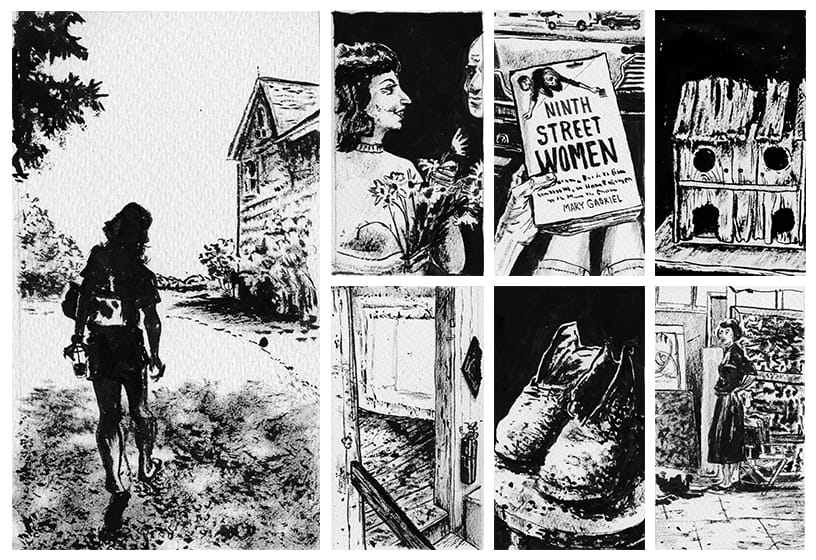
The tour concluded at the gift shop, where the author engaged in conversation with Ward. He recommended a book that would provide a broader understanding of Krasner and other women artists of Abstract Expressionism. The author purchased "Ninth Street Women" by Mary Gabriel and later discussed their artwork with Ward via video call. Contrary to the author's expectations, Ward emphasized the domestic and collaborative aspects of Krasner and Pollock's relationship rather than focusing on Krasner's sacrifices.
Ward described how the couple maintained separate beds and scheduled visits to each other's studios out of mutual respect for their artistic processes. He credited Krasner with managing Pollock's career and personal life, suggesting that his artistic output might have suffered without her support. Ward also highlighted Krasner's practice of revising older paintings, speculating that she may have similarly reassessed her memories of Pollock in the decades following his death.
The author remained unconvinced by Ward's perspective and sought validation from Gabriel, the author of "Ninth Street Women." After reaching out, the author secured a Zoom interview with Gabriel, who was at her home in Ireland. The conversation aimed to explore Krasner's life and legacy further.
Comments (0)
No comments yet — be the first to weigh in.
Related Coverage
 Entertainment
Yayoi Kusama’s Death Signals a Kind Fall for Art and Humanity
Hyperallergic reflects on the passing of Yayoi Kusama, Dolly Parton, and Sliman Mansour, while exploring loneliness, AI, and art's role in a changing world.
 Entertainment
Tessa Hulls on Her Graphic Memoir 'Feeding Ghosts' on Longform Podcast #571
Writer and artist Tessa Hulls discusses her graphic memoir Feeding Ghosts and the project she spent her life avoiding, on Longform Podcast #571.
 Entertainment
Derek Thompson on Longform Podcast: Solving Life's Mysteries Through Writing
Derek Thompson, Atlantic staff writer and Plain English host, discusses his career as a 'dilettante' and love for uncovering mysteries in his Longform Podcast interview.
 Entertainment
Rozina Ali on Longform Podcast #573 Discussing Her Career and Reporting
Rozina Ali, a New York Times Magazine writer and National Magazine Award winner, joins the Longform Podcast to discuss her career and latest reporting.
Most Read
Ian Frazier and Samy Burch Discuss 'Coyote vs. Acme' in The New Yorker

Latin America Energy Storage Forecast Jumps to 34 GW by 2035: Wood Mackenzie


Tarkowski strikes late to rescue point for Everton at Bournemouth
