"Never done before": meteorologist on MTG-I2 leap to predict disasters
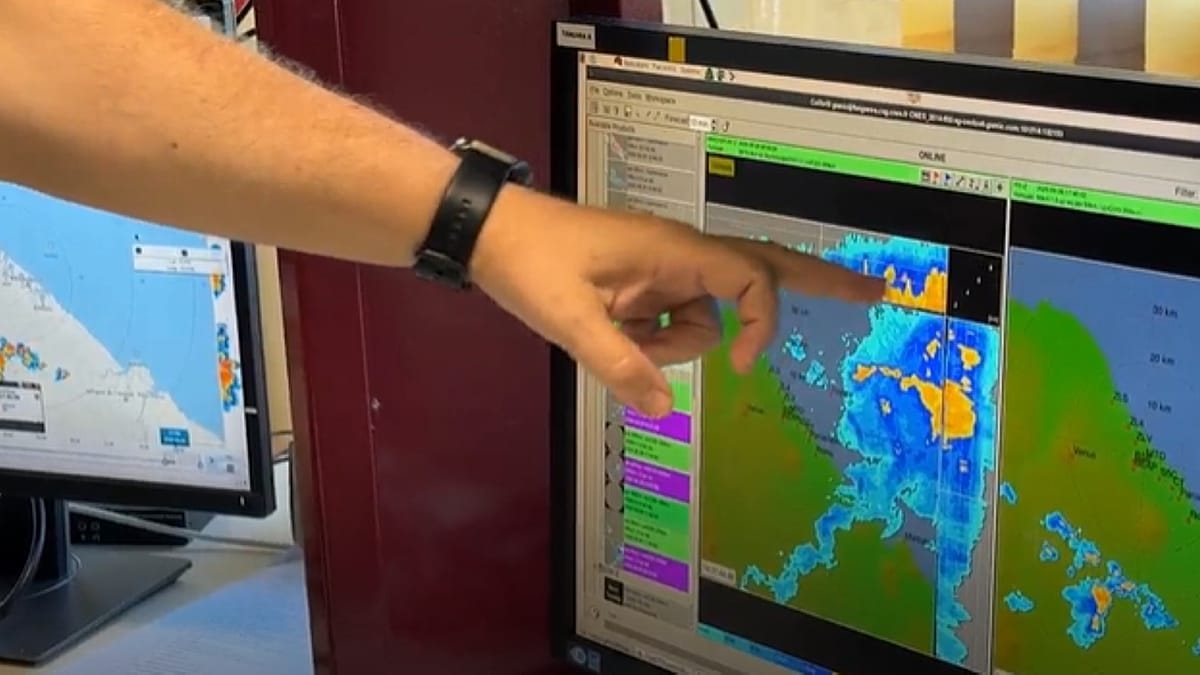
The European Space Agency and Eumetsat have launched the Meteosat Third Generation Imager-2 (MTG-I2) satellite, marking a significant advancement in weather forecasting technology. The satellite lifted off on August 28 from Europe’s Spaceport in Kourou, French Guiana, aboard an Ariane 6 rocket, completing the first operational trio in the Meteosat Third Generation constellation. Positioned 36,000 kilometers above the equator, this satellite will provide constant monitoring of weather conditions across Europe, the Mediterranean, and North Africa.
Panos Giannopoulos, a meteorologist at the Hellenic National Meteorological Service (HNMS) and weather presenter at SKAI Media Group, highlighted the transformative potential of MTG-I2. With 25 years of experience interpreting satellite imagery, Giannopoulos explained that previous generations of Meteosat satellites provided images every 30 minutes with limited channels, while the second generation improved to 12 channels and images every ten minutes. The third generation, including MTG-I2, will scan the upper quarter of the Earth centered on Europe every two and a half minutes—a capability unprecedented worldwide.
Giannopoulos noted that the rapid image capture may exceed human analytical capacity, but artificial intelligence could help fully utilize the data for very short-range forecasting. The new satellite also features a lightning detector, capable of taking 1,000 samples per second, a first for Meteosat. Additionally, the MTG-S satellite, launched in 2025, measures atmospheric humidity and temperature profiles, providing critical data that enhances global prediction models.
MTG-I2 will undergo a six-month commissioning phase before integrating with its sister satellites, with full operational capability expected around April 2027. Giannopoulos emphasized the satellite’s potential impact on both short-term and medium-term weather forecasting, from the next few hours to the standard one-to-ten-day range.
The Ariane 6 rocket’s ninth mission and its first flight to a geostationary transfer orbit marked a significant milestone for Europe’s space capabilities. This launch underscores Europe’s growing role in advanced meteorological and space technology.
#WeatherSatellite #MTGI2 #Eumetsat #ESA #EuropeanSpaceAgency #Meteosat #WeatherForecasting #Ariane6
Comments (0)
No comments yet — be the first to weigh in.

TAP ends first half with almost €100 million loss amid rising fuel costs
Portuguese national airline TAP Air Portugal posted a net loss of 99.2 million euros in the first half of the year, driven largely by surging jet fuel costs lin...

EU Climate Chief Warns China Dependence Raises Green Transition Costs
EU Climate Chief Wopke Hoekstra warns that Europe's reliance on China for clean energy tech could prolong strategic vulnerabilities and inflate costs during the green transition.
Iran fires retaliatory strikes following US attacks on Larak island in the Strait of Hormuz
US military strikes Iranian targets in Strait of Hormuz, prompting retaliatory Iranian missile attacks on US bases in Jordan The United States launched precisio...
Spain beyond the beach: the best places to visit this autumn
Spain remains the top European destination for September travel, accounting for 43% of all bookings—a significant lead over Italy (11%) and France (6%). Accordi...
TAP ends first half with almost €100 million loss amid rising fuel costs
EU Climate Chief Warns China Dependence Raises Green Transition Costs

Real Madrid Crushes Malaga 4-0 as Bellingham, Mbappé, Güler Score

Two terrorists killed during Washuk IBO in Balochistan: security sources
