Methane Thermolysis in Hydrogen Production Faces Carbon Market Challenges
Methane thermolysis produces hydrogen and solid carbon, but scaling up faces market challenges due to the 3:1 carbon-to-hydrogen ratio, requiring robust downstream applications.
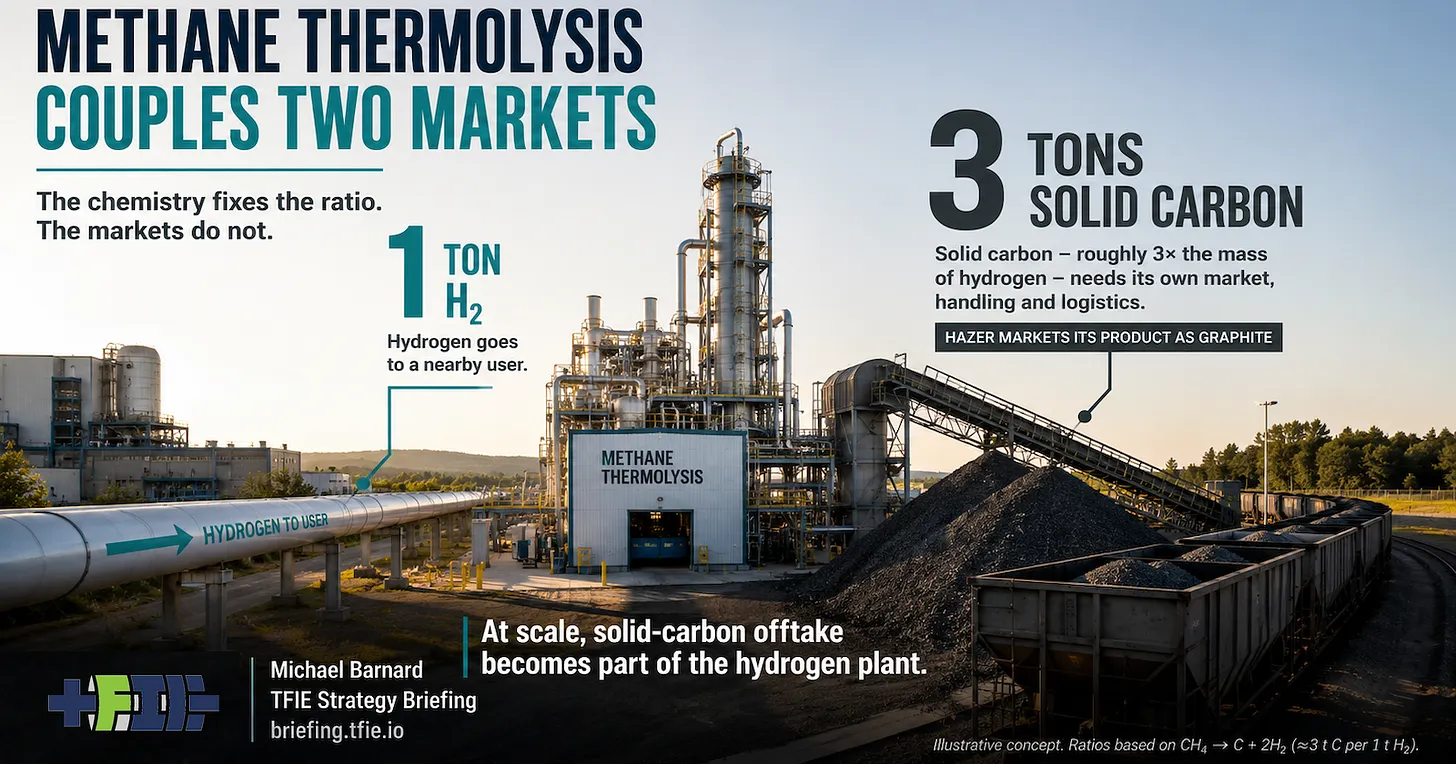
Methane thermolysis, an emerging clean hydrogen production technology that uses high heat to split natural gas into hydrogen and solid carbon, faces a critical commercial obstacle driven by carbon market oversupply. While the process avoids the carbon dioxide emissions and costly carbon capture and storage infrastructure associated with traditional blue hydrogen, a new market analysis by TFIE Strategy Briefing reveals that scaling the technology creates a massive surplus of solid carbon that existing industrial markets cannot easily absorb.
The fundamental challenge lies in the process chemistry, which generates approximately three tonnes of solid graphitic carbon for every one tonne of hydrogen produced. At an industrial scale producing 300,000 tonnes of hydrogen annually, a plant yields roughly 900,000 tonnes of solid carbon each year, or 2,500 tonnes per day. Key industry developers, such as Hazer Group, have progressed catalytic methane pyrolysis from laboratory testing to operational demonstration facilities and commercial engineering partnerships with engineering firm KBR. Hazer aims to supply its high-purity graphitic carbon to sectors including battery manufacturing, steelmaking, asphalt, and concrete.
However, integrated industrial applications show significant supply mismatches. Even in green steelmaking, considered the most favorable dual-product customer for clean hydrogen and carbon, local demand falls far short of output. An analysis of a hydrogen direct reduced iron steel plant reveals that producing the necessary hydrogen via methane thermolysis generates between 340,000 and 365,000 tonnes of graphite annually. Yet a typical 2.5-million-tonne steelworks consumes only 45,000 to 63,000 tonnes of carbon for iron reduction and electric arc furnace operations. This leaves roughly 80 to 90 percent of the carbon co-product needing external buyers.
This mismatch highlights a structural supply-chain issue for the clean energy transition. In conventional markets, carbon suppliers scale production up or down based on direct demand for carbon. In contrast, methane thermolysis ties carbon output strictly to regional hydrogen demand. Because hydrogen is expensive and logistically challenging to transport long distances, production facilities must be located near hydrogen consumers. Consequently, local hydrogen demand dictates where and how much solid carbon is generated, regardless of whether a local market exists for graphitic carbon.
To succeed, thermolysis operators must operate as both hydrogen producers and major carbon logistics and materials management companies. Alternative end-use markets, such as synthetic graphite for electric vehicle batteries or carbon additives for construction materials, face strict purity specifications, high transportation costs, and established competition from petroleum coke, natural graphite, and biochar.
Industry analysts advise investors and energy policymakers not to treat solid carbon co-products as guaranteed revenue streams. Instead, project models must account for carbon quality, customer qualification timelines, localized storage, and market saturation risks to determine the long-term economic viability of commercial methane thermolysis.
#MethaneThermolysis #CleanHydrogen #CarbonMarket #Graphite #HazerGroup #GreenSteel #Global
Comments (0)
No comments yet — be the first to weigh in.
Related Coverage
California Sues Trump Administration Over $120M Wind Power Cancellation
California files lawsuit against Trump administration and offshore wind developer over $120 million reimbursement deal canceling a floating wind farm project off Central Coast.

How Trump Allies Are Stifling America's Electric Drone Revolution
The FCC's proposed ban on foreign-made drones under a 'national security' guise could devastate small businesses, farming, and press freedom while enriching Trump-affiliated firms.
Vycarb Successfully Stores Low-Purity CO2 In Seawater
Vycarb, a Brooklyn-based startup, has achieved a major breakthrough in carbon capture and storage (CCS) technology by successfully storing low-purity carbon dio...
Global PV additions forecast to reach 638 GW in 2026
Global solar installations are projected to reach 638 gigawatts in 2026, according to the latest analysis from Intertek CEA, a solar and storage technical advis...
Trending Now

ECP Issues Notices to Punjab Ministers for Election Code Violations Ahead of By-Polls

WNBA Faces Right-Wing Transgender Controversy Despite No Trans Players
California Sues Trump Administration Over $120M Wind Power Cancellation

