Polar Bear Meets Seal in Stunning Underwater Photo – Wildlife Photographer of the Year 2026
A Norwegian photographer captures a polar bear peering into a seal’s underwater view, earning a highly commended spot in the 2026 Wildlife Photographer of the Year competition.
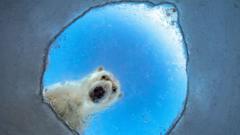
LONDON — Organizers of the Wildlife Photographer of the Year 2026 competition have unveiled a shortlist of highly commended entries, showcasing extraordinary animal behavior and natural landscapes from across the globe.
The overall competition winners will be officially announced on Tuesday, Oct. 13, 2026. Following the announcement, an exhibition displaying the winning and commended images will open to the public at the Natural History Museum in London on Friday, Oct. 16, 2026.
Among the standout entries is an image titled Icy Window, which was highly commended in the Animal Portraits category. Taken by Norwegian wildlife photographer Audun Rikardsen, the photograph offers a seal's perspective of a female polar bear peering down a breathing hole in the Arctic ice. Rikardsen set up an underwater camera equipped with a motion sensor beneath the hole and waited eight hours for the bear to clear the area before retrieving the equipment. Upon reviewing the captured image, Rikardsen recalled being so extremely happy that he was screaming, joking that he probably woke up all the polar bears for miles. Rikardsen previously won competition categories in 2019 and 2025.
The shortlisted images span several categories, capturing complex animal interactions and rare moments in nature. In Norway, photographer Vegard Byrkjeland Aasen used a drone operating for the Norwegian Orca Survey to record an adult killer whale repeatedly carrying a deceased calf to the water's surface in a fjord. Researchers suggest such behavior may represent an attempt to revive or carry the calf, a practice recent studies indicate may be more widespread among the species than previously understood.
Other mammalian highlights include Allegra Hutton's photo of a young leopard stranded in a tree after an unsuccessful squirrel hunt in Botswana's Okavango Delta. In the Central Kalahari Game Reserve, German photographer Jens Cullmann documented an African bullfrog lunging for, and narrowly missing, a babul butterfly.
The collection also highlights urban adaptability and macro photography. In Tokyo, youth entry photographer Sora Miyazawa captured an Eastern Japanese toad navigating a city street after rain, illustrating how the species has adapted to human environments. In Costa Rica, French photographers Andrea and Maceo Grammatico utilized intricate focus-stacking techniques to photograph a mosquito resting on the head of a highly venomous fer-de-lance viper.
Avian photography features prominently on the shortlist as well. Hungarian photographer Bence Máté captured tens of thousands of red-billed queleas descending upon a watering hole in Kenya, while South African photographer Ernest Porter documented a red-billed oxpecker feeding on insects atop a white rhinoceros.
In the Animals in Their Environment category, South African photographer Dewald Tromp captured a Namaqua chameleon braving a sudden sandstorm in Namibia's Namib Desert, highlighting the reptile's specialized adaptations for surviving extreme desert conditions.
Comments (0)
No comments yet — be the first to weigh in.
Related Coverage
 Science
DSM-6 to Integrate Biology in Mental Health Diagnosis for First Time
The DSM-6 will incorporate biological factors for the first time, marking a shift towards evidence-based psychiatry. Explore the challenges and advancements in neurobiology shaping the next edition.
 Science
Islanders asked to report sightings of rare eel
Islanders Urged to Report Sightings of Critically Endangered European Eel in Guernsey Guernsey’s Nature Commission is appealing to residents to report sightings...
 Science
The importance of teaching students what AI can’t do
The growing role of artificial intelligence in education raises concerns about over-reliance on AI tools and the potential erosion of critical thinking skills a...
 Science
More protein in your breakfast or snacks won’t give you more muscle without more work – a biologist separates the science from the marketing
The modern breakfast aisle looks dramatically different than it did a generation ago, with protein-enriched cereal, bread, chips, and even Pop-Tarts now crowdin...
Most Read

Three-storey building collapses at Swaminarayan temple in Prayagraj, no casualties
Kai Bird Explores Roy Cohn's Influence on Donald Trump's America
Canada's Solar Energy Growth: Provinces Chart Diverse Paths to 2035 Goals

Autumn Hill Sentenced to 50 Years in Prison for Anti-ICE Protest: A Case of Political Persecution?
