Endangered parrot eggs hatch after smuggling arrest at Johannesburg airport
Fifty endangered parrot eggs, seized from a Thai suspect at OR Tambo Airport, have hatched under expert care in Pretoria, highlighting South Africa's fight against wildlife trafficking.
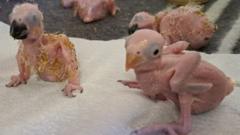
A 50‑year‑old Thai national was arrested at Johannesburg’s OR Tambo International Airport on Thursday after customs officials seized 50 eggs believed to belong to an endangered parrot species. The eggs were found in a homemade incubator bag carried as hand luggage, the Department of Forestry, Fisheries and the Environment (DFFE) said.
The seized eggs have begun to hatch. Staff at the National Zoological Garden in Pretoria are now caring for the chicks, providing intensive care to maximise their chances of survival, the DFFE added.
If found guilty, the suspect faces a fine of up to 10 million rand (about $626,000) or up to 10 years in prison, or both. Initial investigations suggest the eggs belong to a species protected under the Convention on International Trade in Endangered Species of Wild Fauna and Flora (CITES).
The arrest followed a joint operation by the DFFE, the Green Scorpions – a specialised environmental enforcement unit – and several police divisions. Environment Minister David Maynier congratulated the agencies involved, saying, “illegal wildlife trafficking can only be challenged by a co‑ordinated defence of our natural heritage.” He also thanked the staff at the National Zoological Garden, noting that they “have been working tirelessly to incubate the seized eggs and provide specialised care to the hatchlings.”
The incident is part of a growing pattern of sophisticated transnational wildlife‑trafficking networks. In July, a 23‑year‑old Thai citizen was arrested at the same airport for attempting to smuggle 418 parrot eggs. The DFFE said the arrests underline the importance of coordinated, intelligence‑led law‑enforcement efforts.
Wildlife trafficking remains a major threat in South Africa, a country with one of the world’s highest levels of biodiversity. Criminal networks target a range of species, from elephants and pangolins to birds, for sale on the international black market. The illegal collection and trafficking of parrot eggs poses a “serious threat to wild bird populations and animal welfare,” the DFFE said, noting that such eggs are often smuggled in improvised incubators under conditions that endanger the welfare of developing embryos and hatchlings.
To combat the threat, South Africa adopted a new strategy six years ago to strengthen collaboration among government institutions, law‑enforcement agencies, conservation authorities, customs officials, prosecutors and international partners. The goal is to dismantle criminal networks involved in the illicit wildlife trade.
The National Zoological Garden in Pretoria has been monitoring the eggs and hatchlings since the interception. The staff’s efforts are now ensuring that the chicks receive the necessary veterinary and nutritional support to thrive in captivity.
The case highlights the ongoing challenge of protecting endangered species from illegal trade and the importance of international cooperation in enforcing wildlife‑conservation laws.
Comments (0)
No comments yet — be the first to weigh in.
Related Coverage
 Science
DSM-6 to Integrate Biology in Mental Health Diagnosis for First Time
The DSM-6 will incorporate biological factors for the first time, marking a shift towards evidence-based psychiatry. Explore the challenges and advancements in neurobiology shaping the next edition.
 Science
Islanders asked to report sightings of rare eel
Islanders Urged to Report Sightings of Critically Endangered European Eel in Guernsey Guernsey’s Nature Commission is appealing to residents to report sightings...
 Science
The importance of teaching students what AI can’t do
The growing role of artificial intelligence in education raises concerns about over-reliance on AI tools and the potential erosion of critical thinking skills a...
 Science
More protein in your breakfast or snacks won’t give you more muscle without more work – a biologist separates the science from the marketing
The modern breakfast aisle looks dramatically different than it did a generation ago, with protein-enriched cereal, bread, chips, and even Pop-Tarts now crowdin...
Most Read

Three-storey building collapses at Swaminarayan temple in Prayagraj, no casualties
Kai Bird Explores Roy Cohn's Influence on Donald Trump's America

Canada's Solar Energy Growth: Provinces Chart Diverse Paths to 2035 Goals

Autumn Hill Sentenced to 50 Years in Prison for Anti-ICE Protest: A Case of Political Persecution?
