Yayoi Kusama: From Avant-Garde Rebel to Commercially Successful Brand
Exploring Yayoi Kusama's artistic evolution from counterculture icon to globally successful brand, and the implications of her commercialization.
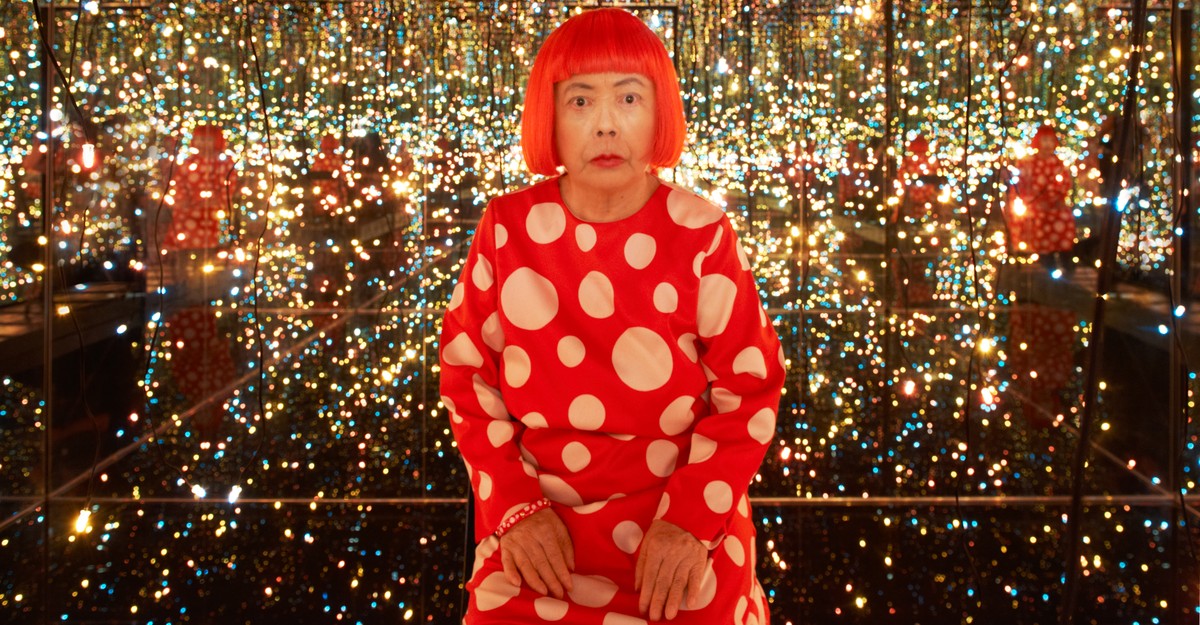
Yayoi Kusama, the renowned Japanese contemporary artist known for her iconic Infinity Mirror Rooms and playful polka-dot motifs, has died at the age of 97. Her passing marks the end of an era for an artist who transitioned from a radical avant-garde figure in the 1960s to a globally recognized brand whose works now dominate museum attendance records and auction sales.
Born in Matsumoto, Japan, Kusama moved to New York City in the late 1950s, where she became a pioneering force in pop art, minimalism, and performance art. Her early works, such as the *Infinity Nets* series, featured expansive, swirling fields of tightly packed dots, reflecting both her artistic innovation and her personal experiences with hallucinations. Kusama’s performances, including painting dots on collaborators’ naked bodies, were acts of protest against the Vietnam War and critiques of the art market, embodying the countercultural energy of the 1960s.
By the 1970s, Kusama had returned to Japan and voluntarily entered a psychiatric institution in Tokyo, where she has resided since 1977. Despite her struggles with mental health, she continued to create art, and in the late 1980s, she reemerged as a major figure in the contemporary art world. Her work gained renewed popularity, particularly after collaborations with luxury brands like LVMH under Marc Jacobs in the 2010s. These partnerships, along with her instantly recognizable polka-dot designs and Infinity Mirror Rooms, transformed Kusama into a global phenomenon and one of the most commercially successful artists of her time.
Kusama’s art, once charged with avant-garde energy and critiques of societal norms, increasingly became associated with market-driven success. Her Infinity Mirror Rooms, which attract long lines of visitors eager to take selfies, exemplify how her work shifted from radical expression to a consumable, Instagram-friendly experience. Critics argue that this transition reflects a broader cultural shift where artistic rebellion is absorbed and repackaged by commercial forces.
Her influence extended beyond visual art, inspiring fashion collaborations and merchandise that made her aesthetic accessible to a mass audience. However, this commercial success also sparked debates about the role of art in consumer culture and the commodification of creativity.
Kusama’s legacy remains complex. She is remembered both as a trailblazing artist who challenged conventions and as a brand whose work became synonymous with market-driven success. Her death closes a chapter on an artist who embodied the tension between artistic integrity and commercial viability.
#YayoiKusama #ContemporaryArt #InfinityMirrorRooms #AvantGarde #PopArt #JapaneseArtists #ArtMarket
Comments (0)
No comments yet — be the first to weigh in.
Related Coverage
Nicole Rifkin’s New Yorker Cover Honors Dolly Parton’s Legacy
Artist Nicole Rifkin’s New Yorker cover commemorates Dolly Parton, celebrating her music and philanthropy. Discover more iconic musician covers.
The New Yorker's Daily Cartoon: August 28th Humor & Caption Contest
Explore The New Yorker's Daily Cartoon for August 28th, featuring humor, a caption contest, and insights from a self-declared next president.
Kai Bird Explores Roy Cohn's Influence on Donald Trump's America
Historian Kai Bird analyzes Roy Cohn's role in shaping Donald Trump's political and personal ethos in this insightful New Yorker feature.
Ian Frazier and Samy Burch Discuss 'Coyote vs. Acme' in The New Yorker
Explore the satirical brilliance of 'Coyote vs. Acme' and its creators in this latest New Yorker feature. Insights into the film's dark humor and cultural impact await.
Most Read

Tottenham Hotspur sign Omar Marmoush on loan from Man City with permanent deal option

Nepal Flash Floods Death Toll Rises to 626, Over 2,400 Missing
Nicole Rifkin’s New Yorker Cover Honors Dolly Parton’s Legacy

Machine Learning Boosts Irradiance Prediction for Bifacial Solar Panels