The First Moon Spaceport Is Coming. But First We’ll Need Moon Traffic Control
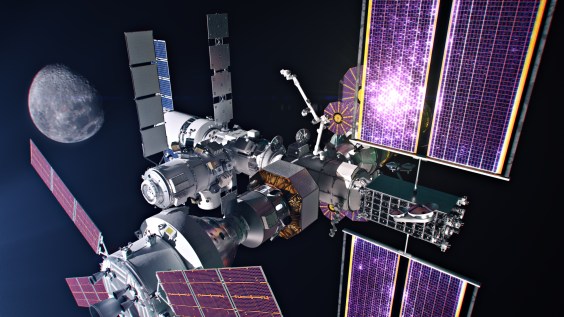
The first lunar spaceport is planned for operation within two decades, according to NASA, but ensuring safe and efficient operations will require an advanced air traffic control system for the moon. Researchers from Texas A&M University, NASA Johnson Space Center, and Purdue University have outlined how such a system might function in a study published in Acta Astronautica.
The proposed system would manage multiple spacecraft sharing the same Near Rectilinear Halo Orbit (NRHO), an elliptical route that will serve as the primary approach for docking with the Gateway spaceport. This orbit passes within 1,000 miles of the moon’s north pole and swings out to 40,000 miles from the south pole. Diane Davis, an associate professor of space engineering at Texas A&M, noted that the NRHO provides a nearly stable, highly elongated orbit around the moon with consistent communication links to Earth and requires minimal propellant to maintain.
However, navigating this orbit presents significant challenges. Spacecraft in the NRHO will experience competing gravitational forces from Earth and the moon, and the proximity of multiple missions increases the risk of collisions or unintended course deviations. Precision maneuvering is essential to avoid such hazards, particularly given the limited fuel available for corrective actions.
To address these challenges, the research team proposed a coordinated approach where spacecraft maintain a "string of pearls" formation, sharing data and continuously recalculating their positions relative to the Gateway. This method ensures safe distances between vehicles and accounts for realistic navigation errors, thruster imperfections, and other disturbances. While this approach requires slightly more fuel to maintain precise orbits, the researchers found that the increased predictability is a worthwhile trade-off.
"The future of lunar exploration depends as much on the traffic management as it does on the rocket science," Davis stated.
The Gateway spaceport, a key component of NASA’s Artemis program, is expected to take several decades to construct. The proposed lunar air traffic control system would operate alongside it, ensuring safe and orderly operations in the NRHO. Further details on operational logistics, such as in-flight services, have not yet been announced.
Comments (0)
No comments yet — be the first to weigh in.
Related Coverage
 Science
Islanders asked to report sightings of rare eel
Islanders Urged to Report Sightings of Critically Endangered European Eel in Guernsey Guernsey’s Nature Commission is appealing to residents to report sightings...
 Science
The importance of teaching students what AI can’t do
The growing role of artificial intelligence in education raises concerns about over-reliance on AI tools and the potential erosion of critical thinking skills a...
 Science
More protein in your breakfast or snacks won’t give you more muscle without more work – a biologist separates the science from the marketing
The modern breakfast aisle looks dramatically different than it did a generation ago, with protein-enriched cereal, bread, chips, and even Pop-Tarts now crowdin...
 Science
Thunderquakes: New Seismic Imaging Method Uses Thunder to Map Earth's Subsurface
Scientists discover how thunderquakes can X-ray the ground below, offering a cost-effective way to map groundwater, sinkholes, and subsurface hazards using existing fiber-optic cables.
Most Read

Russian Drone Strike on Kiev Ammo Depot Kills 37, Sparks Evacuations

At least 37 dead and hundreds evacuated after strike on Kyiv warehouse
Ian Frazier and Samy Burch Discuss 'Coyote vs. Acme' in The New Yorker
Latin America Energy Storage Forecast Jumps to 34 GW by 2035: Wood Mackenzie