Scientists Discover Rare Backward-Walking Sea Robin Fish in Deep Sea
Marine biologists document armored sea robins using unique fin rays to walk, even backwards, in the South China Sea, revealing new deep-sea adaptations.
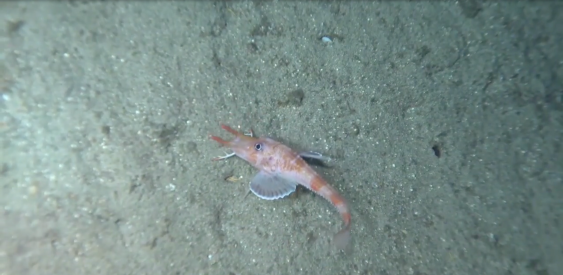
Marine biologists from Sun Yat-sen University in China have documented previously unknown behaviors in three species of armored sea robins, deep-sea fish that inhabit the ocean floor in the South China Sea. Using a submersible, the researchers captured video footage that reveals how these unusual fish use specialized fins to walk both sideways and backward.
The findings, published in the journal Ocean-Land-Atmosphere Research, confirm that sea robins rely on their pectoral fin rays—highly mobile, stiff appendages that extend from the fish’s sides—to move across the seafloor. Unlike typical fish fins, these fin rays function independently, allowing the armored sea robin to maneuver with precision. One species, *Scalicus engyceros*, was observed scuttling sideways and even moving in reverse, a behavior not previously documented in these fish.
The study also highlights structural adaptations that aid the sea robin in its deep-sea foraging. The fish’s pectoral fins have evolved into rounded, skirt-like plates that provide stability while it probes the seafloor for food. Its snout is similarly specialized, featuring paired protrusions resembling tuning-fork prongs and rake-like appendages that extend outward. Researchers suggest these structures help the fish detect and extract prey buried in sediment.
The expedition offered new insights into the sea robin’s sensory capabilities. While the fish showed little reaction to the presence of the deep-sea vehicle, they responded to artificial light by shifting their gaze. This suggests that, despite living in near-total darkness, their eyes retain some light-sensing function.
Study author Han Tian emphasized the broader implications of the research, stating that armored sea robins exhibit far more unique behavioral and evolutionary adaptations than previously recognized. “Ultimately, this research will reshape scientific perceptions of deep-sea biodiversity and reveal how extreme marine environments drive the emergence of one-of-a-kind biological structures and behaviors unseen in any other aquatic organism on Earth,” Tian said.
The discovery underscores the complexity of deep-sea ecosystems and the challenges researchers face in studying them. By documenting these previously unobserved behaviors, the study contributes to a growing body of knowledge about life in one of Earth’s most inaccessible environments.
Comments (0)
No comments yet — be the first to weigh in.
Related Coverage
 Science
DSM-6 to Integrate Biology in Mental Health Diagnosis for First Time
The DSM-6 will incorporate biological factors for the first time, marking a shift towards evidence-based psychiatry. Explore the challenges and advancements in neurobiology shaping the next edition.
 Science
Islanders asked to report sightings of rare eel
Islanders Urged to Report Sightings of Critically Endangered European Eel in Guernsey Guernsey’s Nature Commission is appealing to residents to report sightings...
 Science
The importance of teaching students what AI can’t do
The growing role of artificial intelligence in education raises concerns about over-reliance on AI tools and the potential erosion of critical thinking skills a...
 Science
More protein in your breakfast or snacks won’t give you more muscle without more work – a biologist separates the science from the marketing
The modern breakfast aisle looks dramatically different than it did a generation ago, with protein-enriched cereal, bread, chips, and even Pop-Tarts now crowdin...
Most Read

Autumn Hill Sentenced to 50 Years in Prison for Anti-ICE Protest: A Case of Political Persecution?

Hull City Secure 1-0 Away Win at Coventry, Maintain Perfect Premier League Start
DSM-6 to Integrate Biology in Mental Health Diagnosis for First Time

Russian Drone Strike on Kiev Ammo Depot Kills 37, Sparks Evacuations
